
Is dehumidifier water removal a problem that prevents you from using dehumidifiers? Does the following scenario sound familiar to you? To empty your home dehumidifier, you have to carry a bucket of water from your dehumidifier across the room and pour the water into a corner drain or the laundry sink. Or even worse, you have to carry the bucket full of water upstairs to your kitchen sink—this can be a messy and time-consuming process. Then, once you put the bucket back in place, you may have to repeat this operation two or more times that same day!
Any of the above scenarios play out every day for those who need to use a dehumidifier in their home. During the rainy spring months, our customer service representatives are asked on a daily basis, “What can I do to make removing the water more convenient?” The Fral FDK54 Dehumidifier could be the solution to your problems. This commercial-grade large-space or whole-home dehumidifier is ideal for continuous drainage options as it can be ducted or used as a standalone unit. It’s perfect for homeowners or businesses who want a continually powerful and effective solution for moisture control in large areas. Despite its powerful nature, its compact size makes it perfect for basements, garages, cellars, crawlspaces, warehouses, and workshops up to 2,500 square feet in size. It boasts continuous drainage, a digital humidistat and display, low-temperature operation down to 33°F, and an automatic hot gas defrosting system.
As an alternative to a dehumidifier with a bucket only, you have the option of purchasing a dehumidifier that has an internal condensate pump, like the Dri-Eaz PHD200 or any number of Ebac or Dri-Eaz commercial grade dehumidifiers. If these dehumidifiers are more than what you need in your home, if they do not fit with the decor in your space or if they are simply too expensive, there is another alternative.
At AchooAllergy.com, the best solution that we recommend is to “port” the water from your unit to create a continuous drain dehumidifier. Most people associate the word “porting” with computers and something a ship may do, but porting is an important feature of most of the dehumidifiers that we offer. Porting is the process of using an exterior drain line to drain your dehumidifier continuously.
Dehumidifier Water Removal Option – Gravity Drain
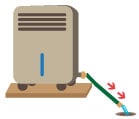
First, hook a hose up to your dehumidifier, then run the line down to a drain.
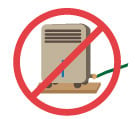
The drain hose cannot be above the drain fitting as this will cause flooding of your dehumidifier.
Porting and Water Removal Options
The porting process is fairly simple but can only work when gravity is on your side. You need to place the dehumidifier in a position that is higher than where you want the water to end up. If this is not possible due to a grade or a lack of a nearby drain, you can still port your dehumidifier, but you will need to purchase a condensate pump for dehumidifiers to push the water up the grade or over a longer distance. If you know this before you buy, you can also consider getting a unit like a Danby 70 pint dehumidifier that can be purchased with a condensate pump already integrated into the unit.
As mentioned above, most room dehumidifiers, like our Danby 50 pint, have a condensate bucket that must be emptied by hand. A float switch turns off the dehumidifier when the bucket is full to prevent overflows. Many dehumidifiers provide a threaded spigot to connect a water hose for drainage. If you have a floor drain or basement sink, you can port the water to the drain by using gravity. Water is continuously being removed from the air, then into the unit, and then down into the drain. You have very little day-to-day upkeep or maintenance with this dehumidifier water removal option.
Typical Installation Steps and Advice
- The first step is to decide where the dehumidifier will go in your home and how you want the water to go out of it. If you want to use the lower cost of gravity, you need to get the dehumidifier off the floor and up at least 6 inches off the ground, even if it’s going to be a basement dehumidifier. Take some time to figure out the placement of your dehumidifier and the final destination of your drained water, as this can save you a lot of time in the future. Make a quick diagram of how you are going to transport the water from point A (the dehumidifier) to point B (the drain).
- Place your dehumidifier on a level surface. You probably need to place it on a wooden skid or concrete block to elevate the unit for proper drainage. You might also want to build a small shelf to elevate the unit. Use adjustable feet or shims and a level to make sure your dehumidifier is level. Even crawlspace dehumidifiers may benefit from being elevated off the ground.
- Most dehumidifiers have a small, threaded hole about an inch or smaller where you can often attach a hose. Some units may include a fitting or adapter for this purpose. The most common size is a 5/8″ opening, which will fit most standard garden hoses. Use this to drain away the collected moisture by taking the end of a standard garden hose and attaching it to the drain fitting of your dehumidifier. Run the hose down to your drain, sump pump, condensate pump, or HVAC drainage line. Restoration dehumidifiers often have these fittings and included integrated condensate pumps as well.
- Instead of a garden hose, you also can use a PVC pipe. Cut and dry fit your PVC pipe to the garden hose adapter. You can make a 90° elbow toward the ground and another 90° elbow at ground level to funnel the water to your drain. When you are satisfied with the look of your drainage system, glue the piping together. Working with the PVC pipe and the glue requires some trial and error, but these items are easy to work with, and you can purchase them at a reasonable cost. If you use PVC piping, the biggest thing you have to worry about is how fast the glue sets. When you apply the glue to the joint and push the pieces together, you have only a few seconds before the glue begins to set, and you will not be able to change the design.
- Plug in your dehumidifier, and you should be ready to go! Make sure that when you plug in your dehumidifier that you do not use small or cheap extension cords. A dehumidifier draws a good amount of power, so you need to use a heavy-duty, grounded extension cord.
- Fill the tank with water to test the setup and ensure it is draining properly—do not pour water through the dehumidifier. Testing the porting system might sound funny, but you want to make sure it works properly before you leave it alone for any length of time. It would be frustrating to leave it and find out later that there is a small leak. If you see water leaking from a clamp, connection, or joint that you glued, apply some more PVC glue to maintain a better seal.
Dehumidifier Water Removal Option – Condensate Pump
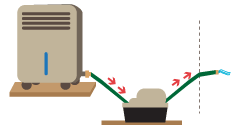
Hook a hose up to your dehumidifier and then run the line down to a condensate pump.
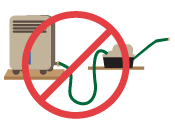
The dehumidifier drain hose nor the condensate pump can be above the drain fitting, or it will cause flooding of your dehumidifier.
Dehumidifier Placement, Operation, and Safety
You must raise your dehumidifier to use gravity for proper drainage. You can put it up on a cement block or build a shelf for the unit to sit on. Always make sure that the dehumidifier is level. The next step is to determine how far off of the ground you must place the unit to allow for effective drainage. The unit must be placed higher than the drain to allow the water to flow downward and away from the unit. This is referred to as a gravity drain.
Most dehumidifiers have top-mounted air discharge and can be placed against walls, but if you do not have top-mounted discharge, make sure the dehumidifier is located away from walls and furniture. By placing the dehumidifier away from the wall, air can circulate freely around the unit. Always place your dehumidifier away from sources of dust and dirt that can clog the coils and grills. This will result in the better and more efficient operation of the unit.
While the dehumidifier is running, keep the doors and windows closed within the space that you are dehumidifying. Keeping the room closed ensures that the space is dehumidified as efficiently as possible.
Observe all manufacturer warnings regarding electrical safety. Never set up water drainage or disposal near electrical circuits or devices. Make sure the dehumidifier is connected to a properly grounded outlet. Keep drain hoses away from electrical cords and connections.
If you are planning to use a hose to drain the dehumidifier’s water bucket, make sure the unit is located close enough to the floor drain or sump to avoid the need for a long and unwieldy hose. Do not create a tripping hazard!
Summary
There are many other reasons for you to use a dehumidifier in your home. You might want to eliminate the chance of rust on tools in your garage or basement workshop. Or you might want to dry out an area in your home that has been saturated by a water leak. For those with allergies, you may want to control your environment and limit your exposure to mold, mildew, and dust mites.
A dehumidifier extracts moisture from the air and is a great way to lower the humidity in any space. Some people quit using their dehumidifiers because of the work that is involved in emptying the water collection bucket. However, the benefits for allergy sufferers, property, and air quality are too important for you not to run your unit. Finally, knowing what dehumidifier water removal options you have can help you to decide which drain system is best for you to utilize in your home.
When you know which dehumidifier water removal option is right for you, shop our full selection of dehumidifiers. If you’d like to learn more about dehumidifiers, humidity, or controlling excess moisture, visit any of our Learning Center articles.
✔ Dehumidifier Buying Guide
✔ How Does a Dehumidifier Work?
✔ Dehumidifier FAQs
✔ Top Five Basement Dehumidifiers
✔ Top Crawl Space Dehumidifiers
✔ Mold FAQs
✔ Common Types of Household Mold
✔ Winter Mold Allergies