
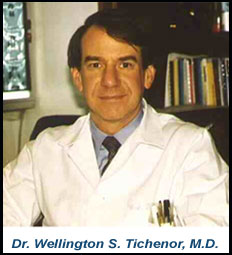
 Dr. Wellington S. Tichenor is an allergist in New York City and the founder of sinuses.com, an extremely comprehensive website that explores the treatment of sinusitis as well as the interrelated problems of allergy and asthma.We recently spoke to Dr. Tichenor about his website and the latest advances in the treatment of sinusitis. A transcript of the interview follows:
Allergy Consumer Report: What inspired you to create such a comprehensive online resource about sinusitis?
Dr. Tichenor: “It’s been up for 11 years now. I started seeing patients with chronic sinusitis about 20 years ago, and then I developed chronic sinusitis myself and had to have surgery twice.
“What I found was that there was a lot of information out there that patients weren’t getting from their physicians, because most doctors don’t understand how to take care of chronic sinusitis. So as a result, I developed a lot of materials in my office prior to the availability of the internet, and then when that became available, I decided that it made sense to put it up there for patients to be able to utilize.”
Allergy Consumer Report: Traditionally, the typical patient with sinusitis would simply be given an antibiotic, but much has changed in the past few years. What are some potential problems with the empiric use of antibiotics in the treatment of sinusitis?
Dr. Tichenor: “Most of the patients who develop chronic sinusitis have it for an extended period of time (that’s why it’s called ‘chronic’), so that these patients will often need to be treated multiple times. The more times we use antibiotics, the more likely the bacteria is to become resistant.
“Secondly, there’s the risk of having side effects with the antibiotics in terms of allergic reaction or any other kinds of problems with organ systems.
“Third is the possibility that one can get yeast overgrowth as a result of being on antibiotics, and the current belief is that a significant number of patients who have sinusitis actually have it as a result of overreaction to mold, yeast, fungi (they’re basically all in the same category). It is normally in the air, and in people with chronic sinusitis, their system sees it as being an abnormal invader and basically attacks it.
“There is also the belief that overusing antibiotics, causing yeast overgrowth, may be one of the causes for a few people to get this problem, with a fungal cause of sinusitis. Another potential reason for [a fungal cause of sinusitis] is mold in the environment, so that it becomes critically important to address mold issues in the environment, and that can be something that is very difficult to do.
“Let me digress for second, back to the current thinking about sinusitis… As a result of studies done at the Mayo Clinic that were first published eight years ago, what has been found is that although fungi normally are present in the nose and are normally present in the environment, that people who have chronic sinusitis will have an abnormal reaction to the fungi.
“And so, what happens is, the body sees it as a foreign invader, and the white blood cells that are used by the body to attack fungi – the eosinophils – will attack the fungi, releasing chemicals which will kill the fungi but will also injure the lining of the sinuses, allowing a bacterial infection to develop.
“One of the developers of this theory has a wonderful video showing the effect of normal eosinophils which will basically sniff the fungi and go on versus the sensitized eosinophils, which will actually attack the bud of the fungus and then destroy it.
“So what we see now in many patients is that there is both a fungal as well as a bacterial cause. The number of patients who have this is not clear at this point.
“The Mayo Clinic hypothesizes that as many as 75 percent or more of patients will have [both a fungal and bacterial cause of sinusitis]. Other people who work in the area think that it may not be as high a percentage. But at the same time, it is possible to speculate that it is a sizable portion.
“In addition, there is also a test now that can be done using the nasal endoscope to take samples, the nasal endoscope being a flexible tube that’s put into the nose, where we can take mucus samples and actually test for this chemical called Major Basic Protein and also for one of the fungi that causes the problem, specifically Alternaria.”
Allergy Consumer Report: As a member of an American Academy of Allergy, Asthma and Immunology (AAAAI) Work Group, you recently completed a paper about nasal endoscopy. The paper is available on your site, and you suggest that people may want to give a copy to their doctor. Can you briefly explain what endoscopy is, what the benefits are, and why some doctors may not be aware of those benefits?
Dr. Tichenor: “The endoscope is a flexible rubber tube which is inserted into the nose, which has a light and viewing source on the end so that we can actually look into the nose and all the nooks and crannies in there. The procedure is typically done by specialists – Ear, Nose and Throat doctors, or allergists – and it allows us to get a much better look at what’s going on in there.
“Now, it also allows us to take direct cultures so that we can see exactly what is going on inside. We can take samples to see what bacteria or fungi are present, and it has been found that doing cultures with endoscopic guidance is as good as actually taking cultures from inside the sinuses.
“The paper that was written, was written to instruct other allergists on how to look at patients with sinusitis, both before as well as after surgery. It’s our belief that allergists are the best physicians to take care of sinus problems because they provide medical treatment for sinus problems, as opposed to the Ear, Nose and Throat doctors, who were trained as surgeons.
“And because we believe now that there is a fungal cause in many patients, the treatment of it really should be medical. What the surgery does is to open the sinuses up, but it doesn’t really do anything about the cause, so that by taking a medical specialist and having them learn all of the things that they need to learn about sinusitis, in terms of its appearance when looked at with the endoscope, both before as well as after surgery, we’re taking someone who has a medical specialty and then teaching them things that they need to recognize in order to be able to treat sinusitis more effectively.
“Traditionally in the past, once people have had surgery, the Ear, Nose and Throat doctors will take care of them, but one of the issues that often happens is that it’s difficult to get Ear, Nose and Throat doctors to actually do cultures from inside the nose, so that if somebody’s been on antibiotics multiple times, often there may be different bacteria outside of the usual ones that may also be resistant to antibiotics, so it becomes much more important to do cultures to find out specifically what bacteria or fungi are in there. We also have found a lot of unusual organisms in the sinuses as a result of doing careful culturing.”
Allergy Consumer Report: What type of environmental control measures do you recommend for people who suffer from sinusitis?
Dr. Tichenor: “First of all, if someone is allergic, it’s critically important to see an allergist and have an evaluation, and I think anyone who has severe sinusitis should have an evaluation, and depending on what one is allergic to, address the environment. For example, if you have problems with dust mites, it’s important to clean up the environment, use mattress and pillow covers, get rid of carpeting, reduce the number of dust catchers, particularly in the bedroom.
“If one has problems with mold, it’s important to keep the humidity down and to look for sources of mold in the house.
“If there has been any water damage at any point, there is a significant possibility that there may be mold there, and it’s important under those circumstances to have an evaluation done by someone who is well trained in dealing with mold problems.
“Unfortunately, a lot of the people who do the evaluations aren’t well trained. If there is mold present, have remediation done. Unfortunately, remediation for mold is similar to asbestos [remediation] and really should be done by someone who is well trained using a fairly complicated barrier system so that the mold isn’t spread into the rest of the house. It can be expensive, typically many times more than the cost of the usual renovations because of the precautions that have to be used.”
Allergy Consumer Report: Your website points out that “about 70% of people with chronic sinusitis have asthma as well.” What is the connection between chronic sinusitis and asthma?
Dr. Tichenor: “There is now a concept of what’s called the Unified Theory of Respiratory Disease, which is the belief that the entire respiratory tract – including sinuses and lungs – are really all one organ, so that if one part of the respiratory tract is infected, typically the balance is affected too.
“It’s because the mucus lining is similar. Also, if one has problems with the sinuses, there will typically be mucus which will drip down the back of the throat and get into the lungs, and that can cause inflammation there.
“It’s also been speculated that there’s a connection via the brain, so that if the sinuses become inflamed, the lungs become inflamed. In addition, one of the things that the Mayo Clinic has found is that as we treat sinus problems, particularly with using anti-fungal agents, the asthma problems in those patients get better. Many of those patients, for example, that may have been on oral steroids will find that they don’t have to be on them, or they’re able to be on a much lower dose of steroids once they start using anti-fungal agents.”
As a matter of fact, according to sinuses.com, a study has begun which will hopefully lead to the approval by the FDA of the first treatment for chronic sinusitis. The treatment involves a new formulation of the anti-fungal agent Amphotericin B. For more information on the study, please contact Accentia Biopharmeuticals.
See our Sinus Problems Solution Guide for more tips on dealing with sinus problems.