
1. How many BTUs do I need to cool my space?
 Before buying a portable air conditioner, it’s important to ensure your investing in the right air conditioner for your needs. You can have a peek at these guys to make the right decision. In addition, you should have your unit installed by professional ac replacement services.
This is why we’ve compiled a list of five things to consider when buying a portable air conditioner. In particular, one of the first things to ask yourself is, how many BTUs do I need to cool my space? When answering this question, you should first consider how large the area is that you need to cool. A safe bet is to check the exact square footage of the space. Next, look at the BTUs (british thermal units) of the unit. These tell you how much cooling energy the AC will provide. Though, at first, it may seem like the more power, the better. You shouldn’t just automatically buy the AC with the most BTUs since larger units do consume more power. You may consult with an ac service contractor if you are planning to buy a portable ac and conduct tune-ups on your ac units.
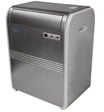 If the area you need to cool is relatively small, purchasing a portable air conditioner like the Haier CPRB08XCJ Portable Air Conditioner with 8,000 BTUs could cut down on operating costs, the purchase price, and the size of the unit. Conversely, the Haier CPN14XC9 Portable Air Conditioner can tackle cooling problems in much larger areas thanks to its 14,000 BTUs. As a guide, you can visit any of our brand pages for each manufacturer we carry. In addition, you can simply refer to the compare portable air conditioners page for a detailed comparison of specs for all portable air conditioner models we offer. In addition, if you’re seeking for an air conditioner repair that won’t break the bank, then you may want to take a look online.
2. Are multi-functional Portable AC units a good idea?
Some portable air conditioners come equipped with dehumidifying, fan-only, and even heating functions. A dehumidifying function is useful in removing moisture from the air, while a fan-only feature may come in handy when temperatures are more comfortable. However, it can be the old jack of all trades, master of none phenomenon. This is especially true when heating capabilities are included in the unit. Tempting as it may be to get a multi-purpose unit. It may benefit you more to get a portable AC that is committed to its primary function as an air conditioner. It’s important to keep in mind that both air conditioners and dehumidifiers essentially function the same way and employ the same mechanisms. Therefore having dual functionality of this type isn’t as much of a stretch as a cooling unit and heating unit combined into one. If you require air conditioning repair, Blue Ridge Heating & Air does air conditioning repair Roanoke, don’t hesitate to give them a call for their professional services.
3. What’s the difference between Dual and Single Hose Portable ACs?
There are two main exhaust hose options for portable air conditioning units, a single hose or a dual hose. You can read more about Dayton Heating and Air, LLC if you’re looking for HVAC services. Single hose air conditioners pull air from within the room only and expel warm air and moisture outside. This creates a negative air pressure since you are pushing air out of the room. As a result, the air has to be replaced in the room and is consequently sucked in from cracks beneath doors or around windows. This warm air, in turn, forces the unit to work harder to keep the room cool. Single hose units, which are simpler machines, do not usually pose a problem when used in smaller settings and are generally less expensive.
On the other hand, dual hose air conditioners feature two air intakes and one air outtake hose. The air intake pulls air from the room, cools it, and then returns it back into the room. This process heats up the unit, so another intake hose takes air from outside to cool the unit down. The second hose expels all warm air back outside. Dual hose systems are more efficient in larger settings.
4. How loud are Portable Air Conditioners?
 Again, answering this question involves considering the room or rooms where the air conditioner will be used. For example, will it be placed in a closed-off sun porch that doesn’t have central AC vents? Is this a room only used for extra space, for kids to play, or for eating a summer evening meal with extended family? Or will the unit be placed in a small upstairs office that gets particularly hot? Do you conduct business calls there that necessitate a quiet environment? While portable air conditioners are not as quiet as central ACs or even window units, DeLonghi portable ACs and Royal Sovereign portable air conditioners tend to be among the quieter models. Many do not make excessive noise and generally fall in the 50-59 dBa category.
5. What type of maintenance is required on a Portable AC unit?
As with most appliances, portable air conditioners require some amount of maintenance. However, the amount of care needed to keep your AC running properly varies according to what model you select. The cooling process of an air conditioner generates moisture that must be removed. Most units contain a tank to collect the water. The tank is emptied in much the same way a dehumidifier with a tank is emptied. Simply pull the tank out of the unit periodically and empty it. Other ACs, however, feature automatic evaporation, which enables the machine to expel moisture outside through the expeller hose. Most of the portable air conditioners we offer feature a combination of both of these. This means cooler air with less work for you.
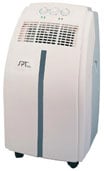 Please keep in mind that the air conditioner could produce more condensate than it can handle, even in units with automatic evaporation. In these cases, a water tank will catch excess fluid. Some units offer a choice of drainage methods. For instance, the Sunpentown WA-1010M Portable Air Conditioner allows you to either empty the tank manually or use a hose for continuous drainage. Most of these units have a drainage outlet at the back base of the unit. You can set up the unit to automatically drain, or you can unplug the drainage outlet and drain the machine into a small pan.
If you have a large home & wish to cool multiple rooms, consult an expert in ac installation services to discuss the different types of air condition systems and help decide which ac best suits your needs.