
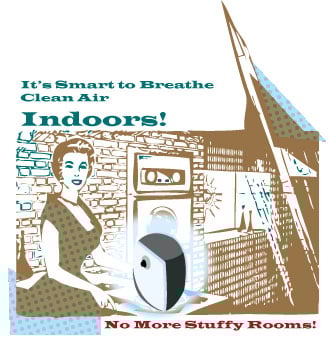
 As many as 8 out of 10 allergy sufferers have allergy symptoms year-round due to indoor air particles. Perennial allergy symptoms can be controlled by improving indoor air quality with air cleaners. These days, there are so many options for air cleaning: furnace filters, HEPA air purifiers, ionic air cleaners, humidifiers that wash the air, ozone generators, and whole house air purification systems . . . which may leave the allergy consumer wondering: What is the history of air purifiers and how did we get this far with air cleaning technology?
You may think that air purification is a relatively new craze, but in actuality, it dates much farther back than most people realize. Although antiquated, various types of air purification have been around for more than 200 years. Since the early 1800s, scientists have been working on ways to make our air cleaner. At the start of the industrial revolution in the United States, John and Charles Dean developed a mask for firefighters in 1823, allowing firefighters to enter burning buildings without being overcome by dangerous smoke fumes.
As the Industrial Revolution really took hold in America, coal burning became a basic way of life throughout growing cities. Utilizing coal allowed engineers to produce electricity and fuel to power trains and heat homes. However, as coal became a central resource for growing city life, the air became polluted with smoke and dark clouds of smog.
It was not until 1854 that John Stenhouse developed a mask worn by divers and coal miners to protect against polluted air. Stenhouses mask was based on a charcoal-based filter design, similar to some of the carbon filters used in air purifiers today. These masks filtered many air impurities and made tremendous advancements in the field of air purification. Using charcoal in his air filters enabled Stenhouse to filter out more harmful, noxious gases from the air than previous filtration masks. In 1871, John Tyndall upgraded the original firefighter masks created by the Deans, introducing a respirator to aid in the breathing for firefighters. The combination of the respirator device and filtration system became early precursors to todays respirator masks.
HEPA Air Filters
Shhh! You may not know it, but HEPA filters were originally classified as top-secret, developed by the US Atomic Energy Commission to protect soldiers from radioactive particles on the battlefield. During World War II, scientists involved in the Manhattan Project used HEPA masks to guard against contaminants from the atomic bomb.
Although these early HEPA masks couldnt possibly protect people from atomic radiation, the research spawned the HEPA filter, which provided protection against chlorine gas, mustard gas, and flame throwers. It was not until the 1960s that specifications were standardized and the term HEPA or “High Efficiency Particulate Air” was officially coined by the Department of Energy (DOE).
As defined by the DOE, HEPA filters remove at least 99.97% of dust, pollen, mold, bacteria and any airborne particles with a size of 0.3 microns at 85 litres per minute. From the beginning, HEPA filters were employed to filter out highly hazardous aerosols, toxic carcinogens, radioactive particules, and biohazardous contaminates.
US Congress passed the Clean Air Act of 1963 to set standards for the reduction of air pollution through fuel emissions standards. Although it was not Congresss first attempt at reducing air pollution, the Clean Air Act of 1963 alerted scientists and consumers of the need to protect our lungs from pollutants such as perfumes, building materials, chemicals, pesticides, and allergens.
The Air Purifier Craze
No longer classified as top-secret, HEPA air filters became popular in the 1970s and 1980s as more consumers became concerned about air pollution. With the introduction of dozens of products featuring HEPA filters, new and exciting ways to control allergies and asthma finally became widely available for residential use. Originally, the first HEPA air purifiers were bulky, difficult to operate, and traditionally used only in hospital and pharmaceutical settings and among computer chip manufacturers. Then businesses began to take notice of indoor air quality concerns among residential consumers.
In 1991, through the amazing technology of True Medical HEPA and Activated Carbon, Richard Taylor created a filter that addressed the issues of environmental particulate contamination, chemical toxicity, and odors. It was then that he and his wife Joyce founded Austin Air Systems Limited. Based out of Buffalo, NY, Austin Air introduced a pre-filter that ensured a HEPA filter life unequaled to anything in the industry. Austin Airs 360-degree intake system draws air into all sides of the air cleaner, maximizing efficiency and delivering more clean air faster. With the largest air cleaner manufacturing facility in the world, Austin Air continues to produce all the parts for their fantastic air purifiers. Read more about Austin Air company history.
Established in 1992, AllerAir quickly became a trusted name in air purification. After a family member of AllerAir founder Sam Teitelbaum developed Multiple Chemical Sensitivity (MCS), Teitelbaum and partner Wayne Martin decided to develop their own air cleaner. Using the combination of true HEPA filters and a MAC-B (mass activated carbon bed) filters, which contain pounds of carbon, AllerAir created an air purifier that safely and effectively removes chemicals, gases, and odors from the air. With offices in the United States, Italy, and Canada, AllerAir air purifiers are used by the Mayo Clinic, IBM, Gucci, Prada, and the U.S. Army. With more than 100 model to choose from, AllerAir air cleaners are efficient, practical, and cost effective.
With headquarters in Stockholm, Sweden, and Chicago, the Blueair air purifier company is committed to creating a healthier environment both indoors and out. Founded in Sweden in 1996, Blueair quickly earned a reputation for high performance, technological innovation, and quality design. A revolutionary combination of mechanical and electrostatic filtration allows Blueair purifiers to capture 99.97% of irritating particles, gases, and odors. With more than five different models, these powerful yet near-silent air cleaners provide a visually-pleasing form and highly effective function. Read more about Blueair company history.
Now a global leader in the production of specialty products and chemicals and a subsidiary brand of Kaz, Honeywell started as a hot water heater company in 1906 and has a longstanding tradition of supplying safe, reliable, and high-quality products. Acquired by Kaz in July of 2002, Honeywells indoor air quality products continually meet and exceed the American Lung Associations Health House guidelines with meaningful innovations based on consumer research and insights. With the use of permanent, lifetime HEPA filters, Honeywell air cleaners remove 99.97% of all common, household particles such as dust, pollen, tobacco, smoke, and cat dander. The Honeywell glass-fiber HEPA material helps remove airborne particles without the use of expensive ultraviolet bulbs, chemicals, or other treatments. With a diversity of products to fit your needs, Honeywell offers a series of Home Comfort and Indoor Air Quality Solutions. Read more about Honeywell company history.
Although no longer a top-secret government project, air purifiers still hold the secrets to cleaner air and healthier environments for many asthma and allergy sufferers. Today HEPA air purifiers and filters are used in a variety of critical filtration applications in nuclear, electronic, aerospace, pharmaceutical and medical fields, as well as in homes around the world. Learn how to choose the best air purifier for your needs. An air purifier could be the secret to better breathing for you and your family.