
If you frequently experience allergies after getting into bed, it may be because you’re allergic to dust mites or their allergens. Even if you don’t notice a difference once you’re in bed, you may benefit from the following solutions we’ve compiled below in our dust mite solutions guide. Unfortunately, the bad news is that if you do suffer from allergies, there is an 80% chance that you might have dust mite sensitivity. The good news is that you can get rid of dust mites and control allergy symptoms with some help from the following products: Allergy Relief Bedding, Air Purifiers, Dehumidifiers, HEPA Vacuum Cleaners, Laundry Detergents & Additives, and various Anti-Allergen Cleaning Products.
Helpful Information on Dust Mites
 |
Dust Mites FAQ |  |
The Facts on Dust Mites |  |
Vacuum Cleaner Buying Guide |
 |
Allergy Relief Bedding Buying Guide |  |
Air Purifier Buying Guide |  |
Dehumidifier Buying Guide |
What Are Dust Mites?
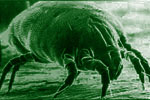 While they may look like insects in magnified photographs, house dust mites are actually arachnids, meaning they’re related to spiders. However, because they’re too small to be seen with the human eye, nobody knew about dust mites until Anton van Leeuwenhoek invented the microscope in 1694. Shocked and horrified to find tiny bugs living all around him, Leeuwenhoek called them “little animals.” The scientific name for dust mites is Dermatophagoides, which means “skin eater,” probably because that’s exactly what they do. Since dead human skin accounts for most homes’ dust, a small clump of dust is like an all-you-can-eat buffet for dust mites. They’re so small that a half teaspoon of dust can contain as many as 1,000 dust mites.
Dust mites love mattresses. They find everything they need in your bed: warmth, moisture, and a never-ending supply of food. Depending on its age, your mattress may contain, on average, between 100,000 and 10,000,000 dust mites. What’s more, dust mite populations can increase rapidly, with each egg-laying female increasing the population by 25 or 30 new mites roughly per week. In addition, the weight of the average mattress doubles after ten years due to dust mite infestation, and the weight of the average pillow increases 10% after one year. If you or your loved ones often wake up with congestion, a runny nose, watery eyes, itching, or sneezing, then you’re most likely allergic to dust mites.
Dust Mite Allergy
As with any allergy, symptoms appear when the immune system mistakes a normally harmless protein for a foreign invader. This protein is what causes the reaction making it known as the allergen. In the case of dust mite allergens, their allergen is an enzyme that helps mites digest skin. This enzyme, found in dust mite feces, not only helps digest dead skin flakes but also destroys the protective function of our living, intact skin, leaving it vulnerable to other allergens and irritants. The enzyme may cause allergic reactions when it touches the skin or when it’s inhaled. During its 80-day lifespan, the average dust mite produces about 1,000 allergenic waste particles. Thinking back to our example in the previous section, this means that half a teaspoon of dust with 1,000 dust mites would contain about 250,000 allergenic waste particles.
Dust Mite Covers – Dust Mite Bedding
 Because dust mites are so small that three of them could fit inside the period at the end of this sentence, we’ve developed specific Dust Mite Mattress Covers in which the pores (spaces in the fabric) are much smaller. When you encase your mattress and pillows with BedCare™, our exclusive allergy relief bedding, neither dust mites nor their allergenic waste particles can penetrate. We also offer a BedCare™ Mite-Proof Pillow, which is made with impenetrable BedCare™ fabric, eliminating the need for an additional encasing. To explain further, BedCare™ Mite-Proof Pillows don’t require dust mite encasings because they’re made with material that’s impenetrable to dust mites. And thankfully, once dust mites are cut off from their source of food (your skin), they will soon die. See our Allergy Relief Bedding Buying Guide to learn more about effectiveness, pore sizes, fabric types, and more.
If you happen to be sensitive to dust mites, you may also want to encase your box springs with a BedCare™ Box Spring Cover. Additionally, inspect other items on your bed that may harbor dust mites and consider using protective covers for these items as well. In particular, to protect your comforter or duvet from infestation, we offer a BedCare™ Comforter Cover. Lightweight, soft, and hypoallergenic, our Polartec 200 Fleece Blankets have also been a long-time favorite among allergy sufferers.
 If you are looking for a new Mattress, consider treating yourself to the best sleep imaginable with a Natural Latex Mattress. Our latex core not only conforms to your body to relieve painful pressure on the spine, but it’s also naturally resistant to dust mites and other allergens.
Dust Mite Control
 Take Control of Your Environment – Other methods of dust mite control involves controlling your environment and making it unhospitable for dust mites. If you take away their food and moisture, they cannot survive. Allergy Bedding protects your mattress and pillows, but dust mites also live in carpet, upholstery, and other places where dust collects. Vacuuming often with a HEPA Vacuum Cleaner as well as cleaning and dusting surfaces with Anti-Allergen Cleaning Products work well to help reduce dust mites. A HEPA filter is a “High-Efficiency Particulate Air” filter, guaranteed to trap at least 99.97% of allergenic particles. If you’re using a vacuum cleaner that doesn’t have a HEPA filter, you’re most likely just moving the allergens around instead of effectively trapping and removing them. Anti-Allergen Carpet Powders & Sprays will help get rid of the allergens, as well as Anti-Allergen Laundry Detergents and laundry additives.
Regulate Indoor Air – HEPA Air Purifiers effectively filter the air of dust, mold, pollen, animal dander, and other airborne allergens. If you are an allergy sufferer considering purchasing an air purifier, be sure to avoid ionic air cleaners, as they can emit ozone. Ozone is a lung irritant that can lead to asthma attacks and other breathing problems. Unfortunately, many popular “air cleaners” actually end up polluting the air with ozone. See our Air Purifier Buying Guide to learn more. Next, Dehumidifiers can reduce dust mites and mold spores in your home by eliminating excess moisture in the air. Dust mites can’t survive without adequate levels of moisture in the air. We recommend maintaining a relative humidity level between 40% and 50%. You may monitor humidity with a Digital Humidity Gauge. Also, see our Dehumidifier Buying Guide to learn more about different dehumidifiers and reducing indoor moisture levels.
 It’s also important to note that you can kill dust mites by simply exposing them to direct sunlight for three hours (take rugs outdoors, for example) or by freezing them. Many parents have also implemented this little trick when it comes to children’s toys by placing them in the freezer for 24 hours to kill dust mites. Alternatively, there are allergy-friendly children’s and animal toys available today made to withstand frequent washing.
Click Here to shop all our Dust Mite Allergen Relief Products!