
This buying humidifier guide features content that is essential for anyone looking to improve indoor comfort, respiratory health, and overall air quality. With so many humidifier styles, features, and price ranges available, choosing the right unit can feel overwhelming without understanding what truly matters. A thoughtful purchasing decision helps ensure the humidifier you choose meets your needs without creating unnecessary maintenance or performance issues.
One of the most important considerations when buying a humidifier is room size. Units are designed to cover specific square footage, and selecting the wrong size can lead to ineffective moisture control or excessive humidity. Over-humidification can encourage mold growth, while underpowered units may fail to deliver noticeable benefits. Matching capacity to space is a critical first step.
Another factor to evaluate is humidifier type. Evaporative, ultrasonic, and warm mist models each offer unique advantages depending on noise tolerance, energy use, and health considerations. Maintenance requirements vary widely between types, making ease of cleaning and filter replacement an important part of the buying humidifier guide process.
Water quality and mineral control should also be considered. Some humidifiers release fine mineral dust if used with hard water, while others incorporate filters or demineralization systems to reduce buildup. Humidity control features such as built-in humidistats and auto shutoff functions help maintain balanced moisture levels and protect indoor environments.
By understanding these core considerations before purchasing, consumers can make informed choices that support comfort, health, and long-term satisfaction. A well-chosen humidifier becomes a valuable addition to the home rather than a source of frustration or upkeep challenges.
For many, having a humidifier in your home is essential to maintain comfort and better control allergies during the drier fall and winter months. Dry air may bring on or aggravate eczema, lead to itchy or inflamed mucous membranes, and dry out allergens, making them airborne and more easily inhaled. Before choosing one to help you this season, take a moment and consider these five things when buying a humidifier. Contemplating each point before investing can help ensure that your purchase is suited to your specific needs and that it will run as efficiently and safely as possible.
Should I get a warm mist or cool mist humidifier?
In terms of humidifying the air in your home, there is really little difference between warm mist humidifier and cool mist humidifier. However, there are specific differences that may make either a warm-mist or a cool-mist unit ideal for you:
- Warm mist humidifiers may be especially soothing for those who have a cold or the flu.
- Most warm mist humidifiers offer germicidal protection by boiling the water before it is released into the air.
- Some warm mist humidifiers can be used in conjunction with medication.
- The boiling water and steam emitted by older warm mist humidifiers could potentially be dangerous if young children are around.
- Warm mist can help make the cold air in your home feel warmer (although humidification in general, whether through warm mist or cool mist, will help make your home feel warmer).
- Cool mist humidifiers are often easier to keep clean.
- Cool mist humidifiers, particularly ultrasonic models, can have much higher moisture outputs.
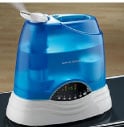 If you cannot decide between warm mist and cool mist humidification, there are a few dual mist humidifier units that allow you the option. Enjoy the best of both worlds with these units that enable you to select either warm mist or cool mist humidification. Just note that often dual mist models only preheat the water. Hence, the warm mist feature is often nowhere near as warm as the warm-mist-only humidifier.
What type of humidifier should I get?
There are a few different ways humidifiers propel moist air into your home environment. These different functions translate to different maintenance requirements. Before purchasing a humidifier, it’s good to know how it works so that you understand how best to care for it and keep it working at peak performance. Here’s a brief breakdown of humidifier types:
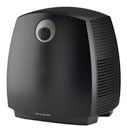 Impeller Humidifiers – use constantly rotating discs to transform water into ultra-fine droplets. These types of humidifiers release cool mist into the air. Specifically, these humidifiers turn their rotating discs, creating an “air washing” like effect. This allows particulates to “stick” to the damp discs. As the discs rotate back into the water, the particulates are removed from the air you breathe. The output of these models is generally not as high as an ultrasonic or warm mist humidifier. However, air washers can be a good way to achieve some benefits of particulate removal.
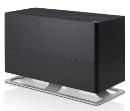 Evaporative Humidifiers – use a fan to draw air over a wet wick, releasing moisture into the air. In particular, the Vornado Evap40 Vortex Evaporative Humidifier is lightweight, low on power usage, and effective. However, evaporative humidifiers do tend to have one drawback. Unfortunately, they can’t warm the water like an ultrasonic or boiler-style warm mist humidifier. As a result, when humidity levels increase, they tend to be somewhat less effective. Some see this as a benefit, though, because this, in turn, leads to them being self-regulating. Overall, most enjoy them because of their easy-to-use top-fill reservoir design.
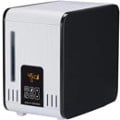 Warm Mist Humidifiers – boil the water, which is then emitted as steam. Not only is this very soothing, but many have optional medicinal compartments. These compartments can be used to vaporize certain medications. On the downside, older models could cause problems if spilled by pets or young children. However, most newer warm mist humidifiers like the AIRCARE ESSENTIALS OZARK Steam Humidifier help reduce or eliminate the chance of burns associated with spilling the hot and often boiling water. In addition, power consumption is slightly higher since the water needs to be heated. Finally, it’s important to note that the “warm mist” feature on a dual mist humidifier is NOT the same, or as warm, as a traditional warm mist humidifier.
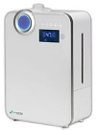 Ultrasonic Humidifiers – produce high-frequency vibrations that turn liquid water into a fine mist. This fine mist or fog is cool in nature and is dispersed into the room via a small fan. This type of humidifier offers the highest moisture output, lowest noise output, and significantly lower power usage. Conveniently, the vibrations used by ultrasonic humidifiers naturally kill most microbes. Due to their high output, low noise level, and an array of features, ultrasonic humidifiers generally come in a variety of models and price points. Check out the Pure Guardian H7550 Ultrasonic Humidifier, one of our top ultrasonic humidifiers.
What germicidal measures should my humidifier have?
If not properly maintained, humidifiers can actually cause more problems than they solve. Standing water can breed bacteria and mold, which are then spewed into the air and inhaled. Thus, humidifiers need to be emptied and cleaned consistently. But improper cleaning in itself can also pose health hazards. When harsh chemicals such as bleach are used to clean the unit, the chemicals can become airborne and inhaled.
Due to the possible risk and high-maintenance nature of humidifiers, manufacturers have taken measures to provide germicidal protection. (Note: These measures do not replace the need for regular maintenance.)
Some germ fighting options include:
- Ionic Silver or Carbon Filters – Air-O-Swiss humidifiers now use their included Hydro Cell (a carbon filter) to help keep the water clean. While Pure Guardian used integrated silver ions in the tank, and Stadler Form opt for the more traditional Silver Ion Cube.
- UV light – Kills microbes safely and effectively, but requires the replacement of bulbs. This method has become less common in favor of carbon or ionic silver.
- Ultrasonic vibration – Kills germs at the same time as water is “shaken” into tiny droplets.
- Boiling/Heat – Warm mist (boiler-style) humidifiers kill germs by boiling water before it is released into the air as steam. Dual mist units prewarm the water in warm mist mode, but often not warm enough to kill microbes.
- Combination – Several units include more than one germicidal feature to provide you with a more well-rounded effort to keep the water clean and hygienic, as well as some added peace of mind.
How many humidifying units will you purchase?
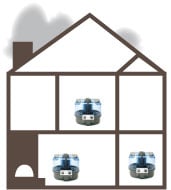 Given the many benefits of home humidification – keeping your home from drying out, offering natural cold and flu relief, and lowering heating costs – you may decide to purchase multiple units. Unfortunately, most humidifiers are single-room humidifiers, whose effects are often slow to reach other rooms, if at all. Therefore, unless you opt for a whole-home humidifier (tied into the existing HVAC system), 1-3 units may be needed for better coverage throughout the home.
If you have young children, you know first-hand how often they pick up colds during the winter months. Moreover, you know how miserable it is for them (and you) to get up in the middle of the night to tend to stuffy noses. Additionally, given the FDA’s recommendation not to give children under two years of age cough medicine or other over-the-counter cold medication, natural relief is more important than ever. Humidifiers placed in children’s rooms offer significant nap-time and night-time relief. The same goes for sick adults. Enjoy the benefits of night-time relief and the good night’s sleep you require through humidification in the bedroom. Some units even feature a medicinal compartment for adding vaporizing cold medications.
If you’re interested in cutting down on heating bills, you may consider humidifying units for other areas of your home as well. Adding moisture to the air – up to a certain level – helps the air feel warmer and lessens the need to turn that thermostat up. Ultimately, a humidifier falls under the same advice as many allergy relief products – start in the room you use the most, namely, the bedroom.
What capacity should my humidifier have?
Deciding what type of capacity you want your unit to have is not as daunting as, say, choosing the square footage for an air purifier. Basically, the larger the capacity of your humidifier, the less often you will have to refill it. However, this must be balanced against considerations like how easy or hard the unit is to refill, how much space you have for it, and how heavy it will be if you have to carry it around to empty or refill it. Many of our largest capacity humidifiers hold nearly two gallons of water and can run for days without needing to be refilled. Our smallest unit, the portable Germ Guardian Table Top Humidifier, holds slightly less than a quarter of a gallon. Other models, like the Stadler Form Oskar, are top-fill models that hold a large amount of water. So, while there is a relatively wide range of humidifier capacities to choose from, your choice largely depends on how much convenience you want.
Once you answered these five things to consider when buying a humidifier, you may find that you’ve effectively narrowed your options down and now have a much easier decision than when you started. While there are certainly other factors to consider before you buy, these five questions are a great place to start.
For more help choosing the right humidifier, see our Humidifier Buying Guide or call one of our experienced and friendly customer service representatives at 1-800-339-7123.